
Revision Guides: Practicing Essay Planning Skills for A Level Students
David Preece, Head of Geography ITE (Teach First)


As we approach the Summer term, our A Level classes shift from learning new content and structures to thinking about exam preparation and revision as specific strands. At GCSE, these moments were often focused on ‘drilling’ knowledge – recognising the high cognitive and vocabulary demands of the course. You could do shed loads of short-answer questions, and do 2-4 mark practices in different ways – mini whiteboards, starters, and peer review etc. – and do high volumes of topic review in different spaces.
As we move to A level, though, that approach feels like something separate. We know that it’s critical to have that knowledge and conceptual understanding, and we know that it’s important that our students are able to master some key ‘drillable’ skills – but we also know that essay writing forms the bulk of the assessment phase, and you can’t easily “drill” that. Or can you?
What are the key skills we need?
To get top marks in essay questions, our students need to be able to master a number of key components of thinking and geographical understanding. They include:
Understanding what the question is really asking. They need to know the command words, and by knowing where the questions are drawn from on an area of the specification (knowing the box), they should be able to effectively identify and understand the implicit parts of the question, not just what’s obviously written. At GCSE, you could take a question at face value. At A Level, you have to be able to know “what else it could be”.
Being able to address the question effectively. Students have to be able to decide how they will answer this question at this moment in time. There’s not a one size fits all structure. So, they have to be able to build and executing a structure, think about how they effectively integrate examples or illustrate their points, and think about how they can construct some form of evaluation.
Actually know their geography really well. It should be obvious, but a beautifully written and constructed essay that is geographically wrong doesn’t score as many marks as good geography does. They need to know their stuff, and think about the case studies and examples in an effective way.
Writing to a high standard. Over time, you’ll have helped them to see what ‘good writing’ looks like, and they’ll have built up some knowledge of paragraphs, starters, stems or phrases that work for them.
Do all this against the clock under exam conditions. So they’ll need to just get used to timing, conditions, and “without notes” or not typing unless they will in the exam. These are all separate skills!
At this stage of the A Level course, they should have some confidence in the geography and what good writing looks like. They’ll have done a few mock or exam conditions in full, and they’ll have learned some exam techniques. You’ll probably have set a few essays over the course in homework or non-timed conditions, too, so they are potentially practiced in writing in non-examined conditions.
So, in my opinion, the highest leverage skills right now are the ones which sharpen the exam thinking, deciding and planning frames. They need to be able to get good at thinking and evaluating effectively, and making good judgements against the clock.
And that’s where essay plans can come in, and why I think they should be a vital part of your summer tool kit.
Why do essay plans?
Writing long form essays is incredibly time-consuming, and gives relatively little information about the key things that we want to prioritise at this time in the course. We want to maximise student thinking and contact time with us – and that means focusing on the skills of decision-making against the clock, and interpreting and constructing a response to a question.
Essay plans are highly efficient. We can present a stimulus question, model and scaffold, and get a strong idea of how good the final essay would be within 10-15 minutes of classroom time – and then repeat. You can do a few in a lesson.
Over a revision period, you can strategically cover most of the key “boxes” of the specification – knowing what types of questions have come up before, and where the essays tend to get asked. There are some topics that it’s almost impossible to set an A Level essay on, and they’ll almost always be short-answer or data response. There are others that practically beg to be essay and debate questions. Students will benefit from having though through most of the most-common essay questions in the revision period.
In order to do a good essay plan, you have to have a plan for content. You can ask them to prep for an essay planning session – “revise x, y and z topics for our lesson” or “focus on this box of the spec”. You can start lessons with a quick recap of factual knowledge, or a chance to ask/identify/correct misconceptions before beginning your essay work together.
Essay plans are modellable. You can do one yourself, under a visualiser, or along side your students. You can get lots of shared feedback and discussion. You can make it a structural routine. All of these build confidence in the decision making process for your students!
As you begin, you’ll probably want to give lots of time – then be really critical about “train like you race”. If you would want them to start writing after 10 mins, and stop after 45, then hold them to that timing. If you think they’d have longer in an exam, draw the line where you need.
Ultimately, there’s no point doing anything they wouldn’t do in exam conditions – so if they want to go away and produce essays (and/or you want to mark them), you have to be confident that they are being done “under exam conditions”. Ideally, you can set them a post-lesson study period – do it in a spare classroom, or in a library or study space, and hand them in by x time. Going home, reading, writing, typing and maybe using research or AI – these don’t help you, or your students at all at this stage.
How can you teach essay planning?
There are four components that go in to making an essay plan effective. Two are fundamental, but specific to the question and your spec. You have to get the geography right, and you have to be able to select appropriate case studies to define, illustrate or exemplify your points. We can’t speak to that here! The two broader skills are worth spending a moment on, though.
First, we have to get students to be able to understand the implicit, and get good at identifying “what else could it be?”. Essay questions are often framed in the sense of “this statement” – do you agree? They should recognise this for what it is – an opportunity to compare this thing against others, and come up with a discussion, and answer. If asked to talk about an aspect (e.g. hazard mapping), they have to know they need to put it in the context of all of the other ways it could be done (e.g. prediction, preparation etc.). You can to practice and understand the different “dimensions” of the answer: know how it could be argue that it’s A, B or C – and be able to “pivot” between the ideas as part of the model essay plan, depending on which of those three options they ask you to argue.
Second, it’s important that students can identify what could it depend on. Show the factors, accept and recognise complexity: it isn’t the case that there are universal “right answers”. Everything has a context. Often, it’s about development – HIC vs LIC and the relative impact of money on what can be done for management approaches and who chooses to spend the money. Sometimes the factors are physical – it might work one way for fluvial floods but very differently for pluvial; or for hard rock versus soft, or constructive versus destructive boundaries etc. These can be conceptual frameworks, they can be specific to an area of geography or specification, but – critically – they can also be practiced and understood.
You can learn essay plans in lots of different ways, but here are two very visual structures that have worked for me and my students.
Essay Technique 1: Washing Line
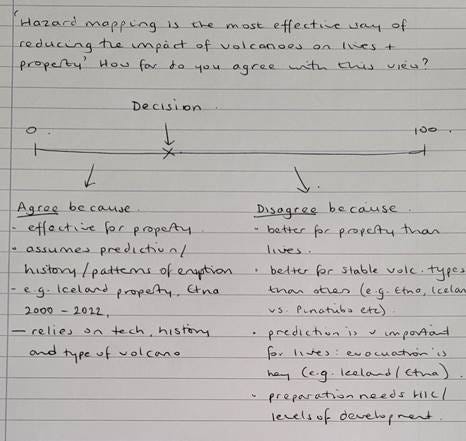
The “washing line” technique works best for “to what extent” type questions with a fairly simple dimension.
Start by drawing the line from 0% agree to 100% agree.
Plot the point for how far you agree.
Start with: describe why you agree – explain what it is, how it works, and illustrate with examples
Then talk about why you disagree: explain each of the reasons, how they work and illustrate with examples
This gives you the structure for the body of the essay. Students need to think about how they’ll write their intro and conclusion, but effectively, they are just describing where the decision point is, and what it is linked to.
Essay Technique 2: Pie Chart
For more complex questions – where there are multiple perspectives, or “factors that it depends on” for your argument, you might prefer to use a less binary structuring tool. A pie chart gives a good visual stimulus to construct an essay on!
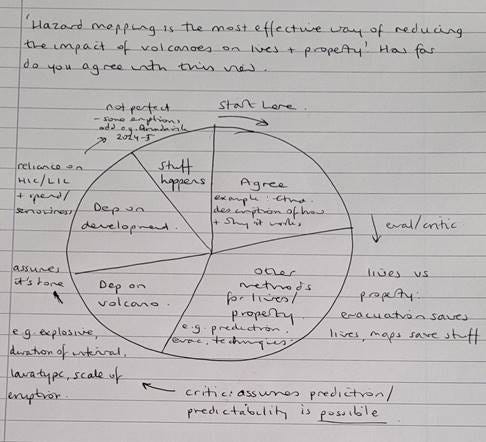
Start top & centre with “agree with the statement”. Say how it works, illustrate with examples, say how significant this is. Could be 75% agreement, for e.g. In this example, you can see there’s some ideas about why hazard mapping does reduce the impact of volcanoes – and I’d be able to use some case studies to illustrate that argument.
Next, give other “yes and” type thoughts. There could be multiple. For example, yes this works, and this works, and this works, and this works – with examples & details for each. In this example, we might say – yes, and prediction works really well because, for example in X, where Y. Or yes, and evacuation techniques and preparedness are really important too. For example, in A, where B and C were…
Next, “but it depends on” example. Here, there’s a physical factor, then a human factor. These would be different paragraphs. This is our context. In this example, we could say that these things work *if* the volcanic context is predictable, and we have effective monitoring to see the build up of approaches. Or we could talk about mapping being really good for effusive type eruptions where the lava flow is predictable, but more challenging for explosive eruptions where it’s less so. We’re almost always able to talk about the importance of the vulnerability and development axis – mapping and prediction rely on investment in infrastructure, and an effective implementation by a country that can govern itself, for instance – and draw out areas where we have examples of how this can make a major difference.
As we come towards the end, we can demonstrate our knowledge of the “Yes, but” type examples. This could be about “weird stuff” that doesn’t fit the paradigm – e.g. unexpected eruptions, multiple hazards (e.g. MSH landslide triggering unidirectional blast), or aspects where the expected outcomes and anticipated processes didn’t work for unusual or human reasons.
You can see how this, too, gives structure to the body of the essay – and perhaps even indicates how much they might want to be writing for each section – intro & conclusions go either side. As part of that conversation – in modelling, and in handing off from one paragraph to another, students should be able to articulate why they’ve given a judgement of how significant each factor is (the extent/scale of each ‘segment of the pie’).
The critical assumptions between each segment allow us to make threshold evaluative statements. For example, you can see that in the first to second segment, I’ve been able to articulate that hazard mapping tends to save property rather than lives – if we want to do that, we need a different technique. That allows me to draw out a critical point in the question, as well as explain why I’m going to talk about prediction, preparation, warning and evacuation techniques. From segment two to three, my critical point is the assumption that prediction is possible – for some hazards, more than others. That leads me to explore… and so on, until you reach a conclusion, which articulates each of these decisions.
The real value of this is not in the content of each chunk, and which case study/geography goes where, it’s in practicing the articulation of why that order and why have you judged it at that level of importance, which are the key skills we can draw out!
Making this work for you
In an ideal world, the structures and thinking of essay plans is done throughout the course, and this might feel a bit difficult to change up now. You may read this, and like the idea of it – but that doesn’t mean that you should automatically introduce it to your students as a “you must” after Easter. You know them – and where they are – best, and it’s up to you to make a cost-benefit judgement about whether it will help or hinder.
If I were introducing it to classes for the first time, I would:
Start with a topic where we know the geography and the essay questions pretty well already. Hazards and the development axis is a good one, and there are other ‘more common’ essay bits where they’ll probably have done a few essays or seen some questions, and be more confident on their subject knowledge.
Set the culture. Praise good decision-making and geographical reasoning – they need to be able to critically articulate and defend their ideas, and we know there are no right answers in evaluation. Mini whiteboards help – for some reason, the quick erase nature means that students are less concerned with “perfection” over progress.
Take my time to model it, and discuss and debate it. I’d do it under a visualizer (rather than on the whiteboard), step by step, and then I’d discuss and debate what I’d do at each point. “So, we’ve got the first line and addressed the first point. What knowledge would we put in here? Would we draw diagrams? What case studies and examples?”. Only once that was done would I move on. You could work in pairs in the first go, if you wanted.
Once we’ve got a completed pie, then I’d encourage them to look at each other’s and debate (or challenge mine as an example) where the lines were, and what the order was. Why did you think this was more important? Great – that’s a really good point – hadn’t considered that. Why did you think that was less important? Oh – because you focused on “people” not “places” – good shout.
Then I’d do another similar question with a varying theme but closely aligned in content. So if we’d done the volcanic hazards question, I’d look at earthquakes.
Finally, we’d sit back and ask “did this work?”. What did we like? What can we see the merits of? What are they less comfy with? If they wholeheartedly endorse it, then maybe you can use it as a technique in further lessons. If some like it, then they can use it. If no one likes it, then we chalk it up to experience and try and move on!
What do you think? What would make it work for you, and what would you want to know for your students?
About the author:
Dr David Preece is Head of Geography for Teach First, leading on curriculum and teacher development in Initial Teacher Education in Geography across England. A former secondary teacher and Head of Department, he taught in SE London for over a decade.
Together with serving on the Editorial Board of Routes Journal, and the GA’s Teacher Education Phase Committee, he has worked with, consulted for and published through the RGS and Geographical Association. He is a Fellow and Chartered Geographer (Teacher) of Royal Geographical Society. His first book on Secondary Geography in Action was published in October 2025. He is regularly on Bluesky, Linked In, as well as writing a blog.